



35th Business Partner Cities conference to take place in Ho Chi Minh City
(TBTCO) - The 35th Business Partner Cities (BPC) Roundtable Conference 2026 will be held on October 23 in Becamex New City Hotel, Ho Chi Minh City.

In his welcome remarks at the 2026 Business Partner Cities (BPC) Roundtable Conference on October 23, Nguyen Loc Ha, standing vice chairman of Ho Chi Minh City People's Committee, said rapid technological advances, supply chain restructuring and rising green development standards were reshaping the business environment, requiring enterprises to continuously innovate to adapt and enhance their competitiveness.
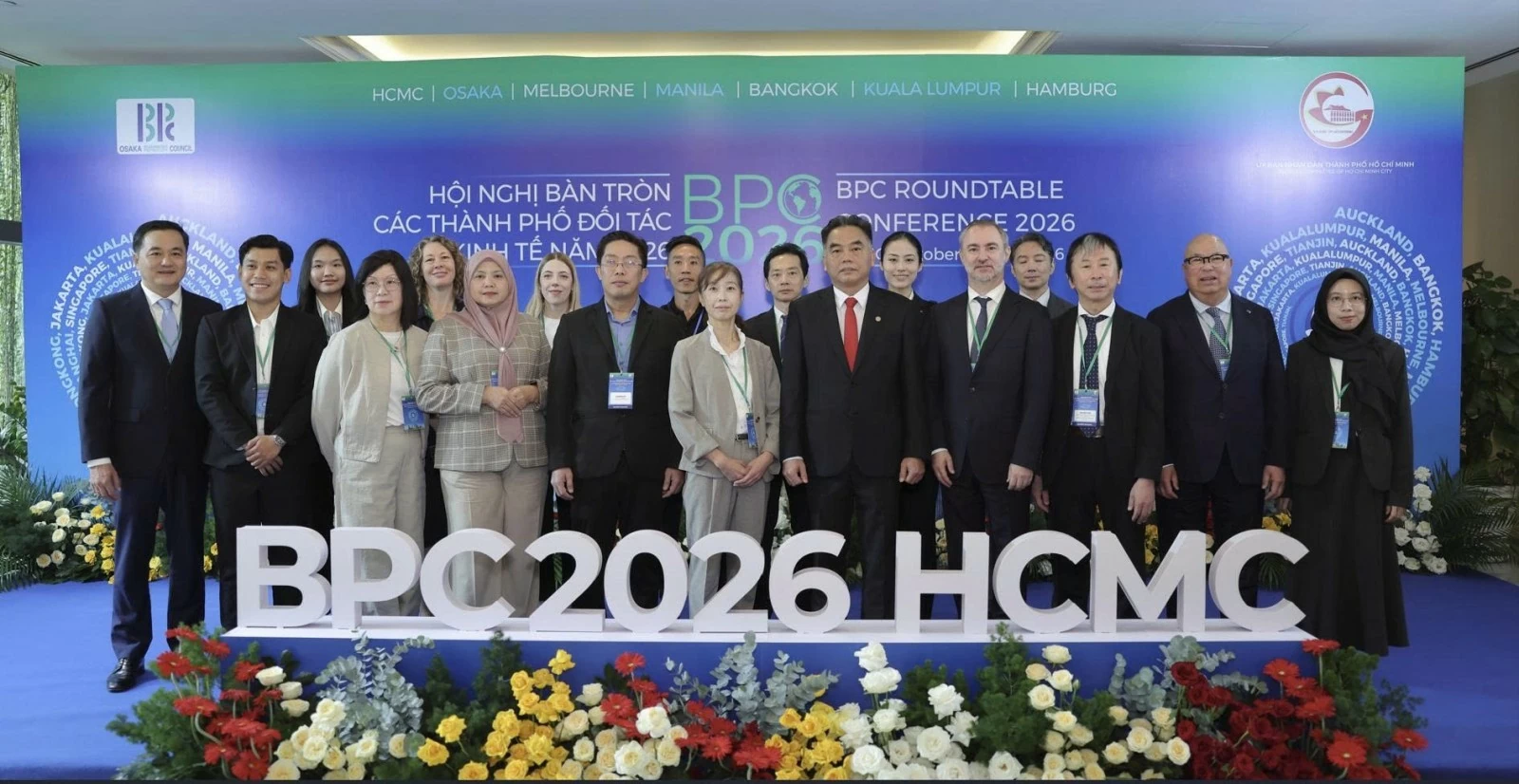 |
| Representatives at the 2026 Business Partner Cities (BPC) Roundtable Conference on October 23 in Ho Chi Minh City. Photo: Ho Chi Minh City People's Committee. Ảnh: BTC |
According to Ha, alongside the need to sustain growth and optimise resources, cities must accelerate digital and green transformation, reduce emissions and reshape urban spaces to improve quality of life.
“Innovation today is about taking new approaches to urban governance, establishing practical support mechanisms and connecting development resources. Through the BPC network, small and medium-sized enterprises have opportunities to access technology, expert knowledge, capital and new markets to support their long-term growth,” Ha said.
He added that urban expansion and an increasingly diverse economic structure are creating improvements for connecting financial services and science and technology with major growth centres in large-scale industry, clean energy and international seaport logistics.
“Innovation and sustainable development are therefore two mutually reinforcing pillars. Innovation drives green growth, while the demands of sustainable development present practical challenges that encourage deeper and more substantive innovation,” he added.
During the discussion, the balance between industrial growth and carbon emission reduction targets was raised with representatives of Ho Chi Minh City's industry and trade sector.
Ha Van Ut, deputy director of the Ho Chi Minh City Department of Industry and Trade, said economic growth, social progress and environmental protection were not conflicting objectives, but needed to be pursued simultaneously. However, a major challenge for businesses, particularly smaller ones, was securing the resources needed to implement green and digital transformation.
“Businesses need support from government agencies and international partners through green credit, technical consultancy and appropriate transition roadmaps. These are essential conditions for enterprises to gradually meet environmental requirements without disrupting their production and business operations,” Ut said.
Zaimah Osman, trade counsellor at the Malaysia External Trade Development Corporation in Ho Chi Minh City, said public-private cooperation could help scale up sustainable development solutions.
“The public sector plays a role in creating a favourable policy environment, facilitating access to finance and incentive policies, and promoting international cooperation. The private sector contributes technology, investment capital, innovation and market experience to turn ideas into commercially viable solutions,” said Osman.
Bringing public and private resources together can bridge the gap between innovation and market application, enabling green solutions to be deployed on a larger scale, including across borders, Osman added.
Meanwhile, Numero Lim, a city councillor for Manila in the Philippines, stressed that policy feasibility was essential to securing public and business participation in the green transition.
According to Lim, effective policy implementation requires three key elements: clear legislation, realistic budgets and the involvement of business partners. Regulations should not be overly complex or impose burdens that make compliance difficult for small traders, household businesses and small enterprises.
“In Manila, the authorities focus on zoning and industrial clustering, assessing potential environmental impacts before allowing an industry to operate within a community,” Lim said.
Melbourne’s experience shows that attracting investment into emerging industries also requires strict control over environmental impacts.
 |
| International delegates discussed at the event. |
Kevin Louey, city councillor and chair of the Economy and Business portfolio in Melbourne, said the growth of AI was attracting significant capital into data centre projects. However, such infrastructure consumes substantial amounts of electricity and water, raising the challenge of balancing economic benefits with emissions reduction targets.
“Melbourne works with state and federal governments on planning, while seeking to relocate data centres away from the inner city to satellite cities or designated clusters to ease pressure on urban space and infrastructure,” Louey said.
He added that the city does not seek to prevent data centre development, but requires investors to adopt green technologies, prioritise water reuse and energy efficiency, and assess environmental impacts before projects are approved.
“This approach shows that sustainable development is not only a requirement for manufacturing businesses, but also a consideration in decisions involving urban infrastructure and services. Investment attraction mechanisms need to be accompanied by clear environmental criteria, while businesses must factor in resource efficiency from the project design stage,” he added.
| Discussions at BPC 2026 highlighted that international cooperation should go beyond the exchange of experience to facilitate connections in capital, technology and implementation capacity. For Ho Chi Minh City, the goal is to turn links between government, trade promotion organisations and the business community into concrete cooperation programmes, helping enterprises strengthen their competitiveness and promoting green and sustainable growth models. |