





Heineken to shift production from Singapore to Vietnam and Malaysia
Dutch brewer Heineken will shift its brewing production from Singapore to Vietnam and Malaysia as part of its strategy to build a more agile regional supply approach.


 |
The US–Iran conflict has significantly increased the risk of supply disruptions in the Middle East, particularly at the Strait of Hormuz, which accounts for more than 15 per cent of global seaborne oil trade. This could trigger a short-term supply shock.
Investment channels are facing a clear divergence as capital tends to shift towards safe-haven assets, while investors become more cautious about high-risk assets.
According to VnDirect, gold prices could surge sharply in the near term, revisiting previous highs of $5,500–5,600 per ounce as investors favour safe-haven assets. However, profit-taking may quickly follow if signs of de-escalation emerge and parties return to negotiations.
In the middle term, beyond Middle East tensions, gold’s trajectory will continue to be supported by the global trend of reducing reliance on the US dollar and diversifying central bank reserves, particularly among BRICS nations; and the US’ persistent fiscal deficits and mounting public debt.
The USD may strengthen in the near term, supported by its safe-haven status and the US position as a net energy exporter. Concerns over inflation risks could also prompt the Federal Reserve to delay rate cuts, reinforcing upward momentum for the dollar.
In the middle term, the dollar faces mixed forces. Persistent inflation risks may lead the Fed to postpone policy easing, lending further support to the currency. On the other hand, if geopolitical tensions escalate and persist, renewed inflationary pressures could erode US consumer purchasing power and slow economic growth, weighing on the dollar.
Cryptocurrencies are increasingly viewed less as safe havens and more as high-risk assets, akin to equities. Amid heightened Middle East tensions, investors tend to rotate away from cryptocurrencies towards traditional safe havens such as gold and the US dollar.
In the middle term, the trajectory of Bitcoin and digital assets will be shaped by several factors. First is global liquidity and monetary policy of major central banks, given crypto’s high sensitivity to liquidity conditions. Second is regulatory reforms that could pave the way for broader adoption. Third is advances in blockchain technology and the broader tech ecosystem. Fourth is institutional demand, as investment funds allocate to crypto for diversification purposes.
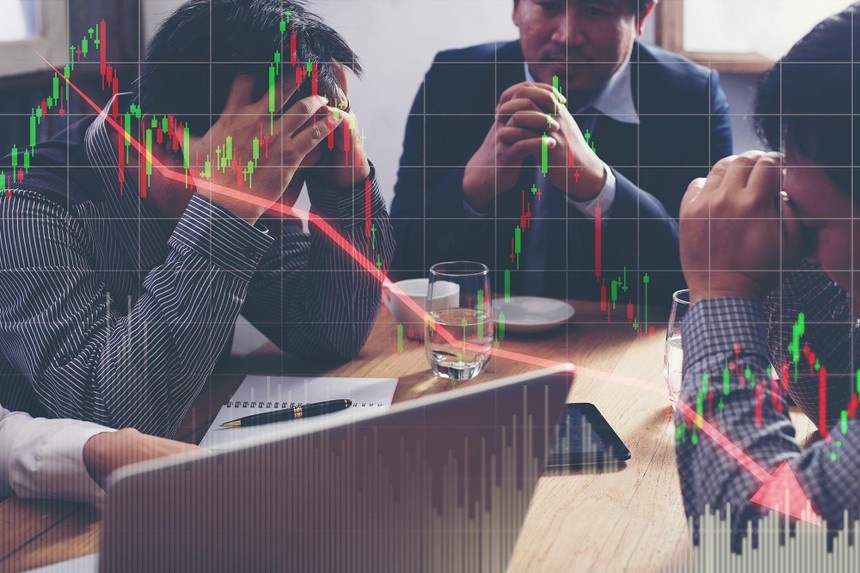
VnDirect also pointed out the negative short-term outlook of stocks. Specifically, risk capital typically withdraws from equities while investors gauge economic fallout. Indices may face brief corrections but tend to stabilise if tensions do not escalate. Sector performance will diverge: energy, fertilisers, shipping, and rubber may gain, while aviation and import-heavy industries could suffer.
There are two scenarios for stocks in the medium term. In Scenario 1 (more likely), where US–Iran tensions cool within weeks, disruptions to global energy supply chains should remain manageable. Market sentiment may recover, with attention shifting to central bank monetary policies, 2026 corporate earnings guidance, FTSE’s market upgrade review, and Vietnam’s Q1 2026 macro data. The VN-Index could head to around 1,900 points by late Q1 2026 to early Q2 2026.
In Scenario 2, where tensions escalate into regional war, driving oil prices above $100/barrel, global growth could falter while inflation resurges. This would constrain monetary policy flexibility worldwide and trigger deeper market corrections. The VN-Index could retreat and consolidate near the 1,700-point level.