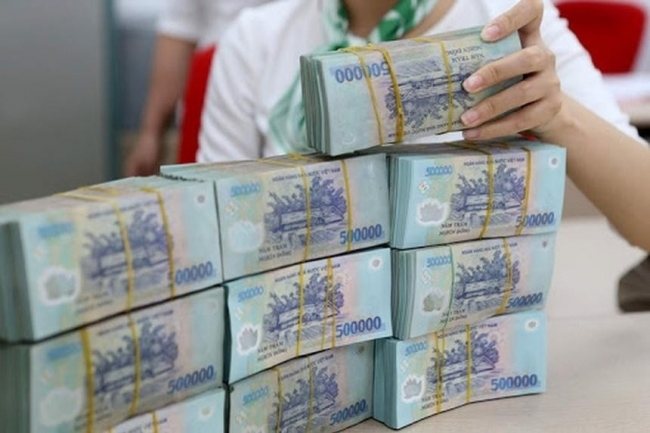






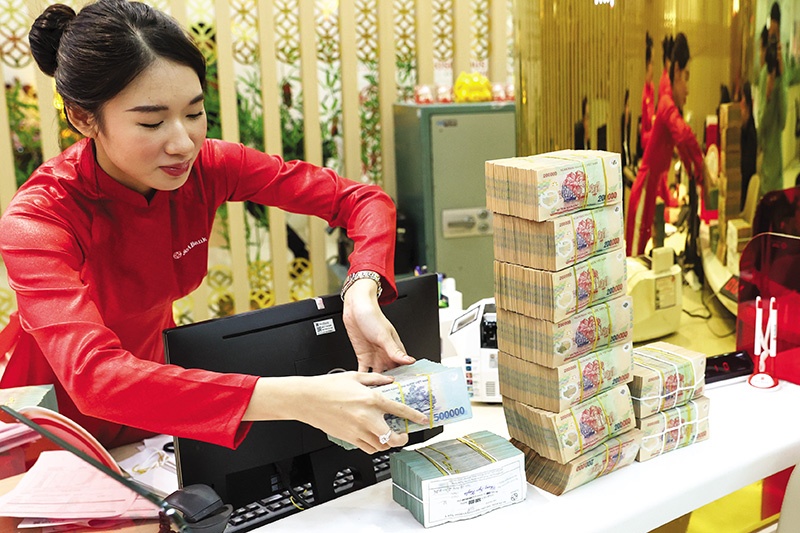
Since early November, more than 20 banks have increased deposit rates, expanding the trend beyond smaller institutions as major lenders also adjust their policies.
The banks include Vietcombank, Techcombank, VPBank, Sacombank, MB, VIB, LPBank, HDBank, BVBank, PVCombank, Bac A Bank, Nam A Bank, NCB, TPBank, OCB, VCBNeo, and Vikki Bank, among others.
“Over the past two months, deposit rates at joint-stock commercial banks have increased noticeably, particularly across mid-term tenors,” said Le Hoai An, a certified financial analyst and founder of Integrated Financial Solutions and Services JSC.
 |
Many banks have adjusted rates two or three times within a single month, with certain tenors climbing by 0.3–0.7 basis points (bpts) per year.
For 12–18-month terms, the common deposit rate range is 4.7–5.3 per cent annually, but some smaller banks or online channels have pushed rates to 6–6.2 per cent, while large state-owned banks remain around 4.8–5 per cent. This indicates rapidly rising funding costs and clear pressure on banks’ cost of capital.
As deposit rates and interbank rates increase across most tenors, liquidity stress has become more apparent, prompting the State Bank of Vietnam (SBV) to accelerate liquidity injections via the open market.
Continuing the upward trend, on November 25, the average VND interbank offered rates surged by 0.45–0.70bpts across all sub-one-month tenors versus the previous session, with overnight transactions at 6.5 per cent, one-week at 6.5 per cent, and one-month at 6 per cent.
Marking the sixth consecutive week of net injections, the SBV continued to add liquidity on the open market on the week running from November 17–24.
On November 21 and 24, the SBV expanded disbursements to certain banks via term purchases, with $1.32 billion and just over $2 billion respectively at a 4 per cent annual rate to support month-end liquidity.
On the lending side, average rates for new loans currently hover around 6.55 per cent annually – up slightly from the previous month and still below late-2024 levels.
In practice, short-term packages are usually fixed at around 7–7.5 per cent for three- to six-month terms before shifting to floating rates of around 8–8.5 per cent. Medium- and long-term loans are typically fixed at 7–7.75 per cent for 6–18 months, after which rates may rise to roughly 9.4–9.7 per cent.
A senior executive at a Hanoi-based joint-stock commercial bank told VIR that the misalignment between credit growth and deposit growth became apparent when liquidity pressures emerged from the first half of October.
“As deposit rates rise, lending rates inevitably must follow,” the executive noted.
Higher lending rates are now a reality borrowers must face. After initial preferential periods, homebuyers move to floating rates, meanwhile first-year promotional lending rates in November also increased by 1–2bpts compared to October. Specifically, the rate at ACB stands at 8 per cent, ABBank at 9.65 per cent, Sacombank at 7.49 per cent, VIB from 7.8 per cent, BVBank at 8.49 per cent, among others.
Commenting on these developments, an SBV official said they increasingly reflect actual market conditions.
According to SBV data, as of November 21, total outstanding credit reached $725.6 billion, up 16.15 per cent year-to-date, up 0.73 per cent on-month, and up 20.3 per cent on-year.
Total deposits reached $685.68 billion, up 12 per cent year-to-date, up 0.75 per cent on-month, and up 16.07 per cent on-year.
In a related development, banks are not only mobilising expensive domestic deposits but also borrowing abroad in US dollars where the cost remains high.
The USD borrowing is often leveraged to the Secured Overnight Financing Rate (SOFR) plus a margin. The SOFR was 4.01 per cent as of November 25. This benchmark reflects the cost of overnight cash loans collateralised by US Treasury securities.
“Currently, a Vietnamese bank taking a three-year medium-term USD loan would face a rate around SOFR at 4.01 per cent plus a 2.5 per cent margin. However, the effective rate is not just 6.51 per cent because SOFR-based loans accrue interest on a daily compounded basis. Additionally, foreign borrowing carries several fees. Altogether, the total cost comes to roughly 6.7–6.8 per cent,” said one industry insider.
Dinh Duc Quang, head of Treasury at UOB Vietnam, said, “As long as the US market has not truly begun monetary easing, other markets will not be able to cut rates aggressively. All markets globally are striving to retain USD capital flows by balancing interest returns, exchange rates, and Vietnam is no exception.”
| Nguyen Tu Anh, research director at VinUni University
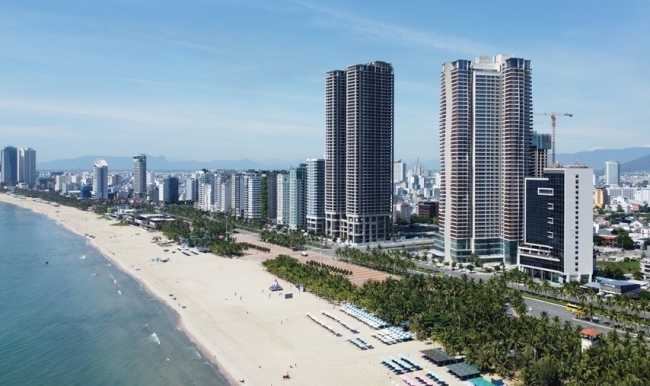
Recent reports by the Vietnam Association of Realtors (VARS) and real estate consultancy firm CBRE show that although prices remain high, liquidity in the real estate market is still very healthy. However, most property buyers are purchasing for speculative purposes, and they are primarily members of the middle class- the group holding the largest amount of idle capital in the economy. This idle money has shifted from the banking system into real estate. In principle, this money should return to the financial system when property developers receive it. However, surging real estate prices are encouraging developers to invest in new projects. As a result, the funds are not flowing back into the credit system but are instead being recycled into a new investment cycle. This explains why credit-system liquidity becomes strained even when market activity is strong. From a financial-system perspective, illiquidity in the secondary real estate market heightens the valuation risk of collateral assets. Banks must adjust collateral valuations downward, increase provisioning, and tighten credit conditions for related loans. The risk premium therefore rises, forcing lending rates to adjust accordingly to compensate. This is a major transmission channel through which the property market affects the overall interest-rate environment. In addition, when capital is pumped strongly into the market- as seen in very high credit growth- inflation expectations rise. This discourages people from holding money (cash or deposits) and prompts them to shift toward holding assets. This also reduces deposit supply, forcing banks to raise deposit rates to rebalance their funding. When real estate- which accounts for a large share of total national assets- enters a ‘capital lock-in’ state, the amount of effective capital in the economy declines, while businesses’ working-capital keeps flowing. The imbalance between capital supply and demand makes it difficult for interest rates to fall, and they may even edge up during periods of liquidity stress. This poses a risk to the economy, especially because the issue is not merely temporary but is likely to persist as a broader trend. |