


 |
How does Vietnam’s potential for an International Financial Centre (IFC) compare with other Southeast Asian markets, and what advantages does it offer internationally?
Vietnam is at a genuinely exciting point in its economic journey. Compared with other markets in Southeast Asia, it combines strong growth fundamentals with a clear and deliberate policy push towards deeper international integration. The government’s commitment, reflected in the National Assembly’s Resolution No.222/2025/QH15 and the dual-location IFC model spanning Ho Chi Minh City and Danang, sends a strong signal of both ambition and strategic clarity.
From an international perspective, Vietnam has two particularly compelling advantages. The first is its young, highly adaptable talent base. ACCA has been active in Vietnam for more than two decades, and we have consistently seen how quickly the profession responds to change and rising expectations. The second is Vietnam’s proven willingness to embrace global standards. That openness to alignment is critical for any financial centre seeking international credibility.
When you combine these strengths with Vietnam’s growing role in green finance and digital innovation, the proposition becomes even more attractive. For global investors looking at ASEAN, Vietnam increasingly stands out as a market that offers growth, reform momentum and long-term strategic intent.
What lessons can Vietnam learn from successful IFCs, and what pitfalls should it avoid in a region with established players like Singapore, Hong Kong, and Dubai?
The most important lesson is the need for balance – robust governance and adherence to international standards, alongside enough flexibility to allow innovation to flourish. Dubai’s IFC offers a useful example. It introduced controlled environments such as innovation testing licences and tokenisation sandboxes, enabling fintech and digital finance to develop without undermining trust or stability.
For Vietnam, differentiation will not come from replicating existing models, but from leveraging its own strengths. The dual-location concept is a smart starting point. If Vietnam can position itself at the intersection of green finance, environmental, social, and governance (ESG) standards, and fintech, it has the potential to become a regional destination for sustainable investment and digital financial solutions.
That said, the foundations must be right. The adoption of International Financial Reporting Standards (IFRS), high-quality assurance, credible supervision, and a strong pipeline of globally competent professionals are non-negotiable. Without these elements in place, it is difficult to compete in an increasingly interconnected and standards-driven global financial system.
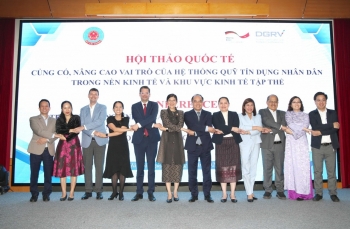
The MoU between ACCA and KPMG is a key milestone. Can such partnerships speed up Vietnam’s adoption of global standards, and are there risks in applying international frameworks locally?
Partnerships of this nature are essential. They bring global expertise, practical experience and proven best practice directly into policy and implementation discussions. However, success does not come from simply copying what works elsewhere.
The real challenge lies in adaptation. International frameworks must be calibrated to Vietnam’s regulatory environment, institutional capacity and stage of market development. Moving too quickly without sufficient capability-building can create implementation risks.
This is where ACCA’s role becomes particularly important. We help translate global standards into practical, workable steps for regulators, businesses and professionals. The objective is not speed for its own sake, but credibility and sustainability from day one.
The UK’s financial ecosystem offers a strong reference point, given its emphasis on governance, professional standards and globally interoperable regulation. Partnerships drawing on that experience provide Vietnam with solid foundations that can be tailored to its own ambitions.
Our experience across both established and emerging financial hubs is also relevant. Cross-border capital flows depend on confidence in financial reporting, audit quality, risk management, tax and legal frameworks, as well as talent development. Through our combined global networks, ACCA and KPMG support the building of an IFC grounded in internationally recognised standards such as IFRS, supported by transparent supervision and sound governance.
What does this MoU indicate about wider Asia-Pacific trends, and how can Vietnam position itself as a regional leader?
This MoU reflects a broader shift across Asia-Pacific. Capital flows and supply chains are increasingly gravitating towards ASEAN, and financial infrastructure must evolve accordingly. Global investors are looking for trusted gateways into the region, and well-designed international financial centres are part of that solution.
Vietnam has a real opportunity to lead, not by trying to replicate Singapore or Hong Kong, but by carving out its own niche in green finance, fintech and regional connectivity. If Vietnam gets this right, its IFC can serve as a bridge between Southeast Asia and global capital markets.
Partnerships like this one between ACCA and KPMG are an important first step. They signal intent, credibility and a willingness to build on global experience while shaping a distinctly Vietnamese model for the future.
How does IFRS adoption relate to financial integration and transparency, especially in the context of ESG and green finance?
They are inseparable. IFRS and international standards are, in effect, the language of trust in global finance. Without them, attracting long-term capital, especially green and sustainable investment, becomes significantly more difficult.
Investors are looking for comparability, transparency and assurance. International standards provide exactly that. For Vietnam, embracing IFRS and ESG is therefore not simply a compliance exercise, but a clear competitive advantage. It positions the country as a credible and responsible participant in global capital markets.
Increasingly, investors also expect assured ESG disclosures aligned with global frameworks, supported by reliable data, strong internal controls and independent verification. Without this rigour, ESG risks becoming narrative rather than actionable insight.
Audit quality and market trust are equally critical. High-quality audits, strong governance at both firm and board levels, and effective enforcement mechanisms all play a role in reducing risk and building long-term confidence.
Through this collaboration, ACCA and KPMG support regulators with technical input on IFRS and ESG standards, share global best practices, and deliver training for IFC teams, finance leaders, auditors and risk professionals, enabling them to operate confidently to international standards.
ACCA has supported Vietnam’s finance profession for over 20 years. How does the IFC initiative build on this and align with ACCA’s global mission?
For more than the past two decades, ACCA has worked with Vietnam’s regulators, universities, and employers to professionalise the finance and accounting talent base and to bring international standards into day-to-day practice. That work continues at pace.
In 2025, for example, we supported the profession’s sustainability disclosure journey by releasing the first Vietnamese terminology set aligned to IFRS S1-S2 to help remove language barriers for issuers, auditors, and regulators as Vietnam moves towards global alignment
Vietnam’s IFC roadmap now gives that long-running agenda a new, catalytic platform. Resolution 222 and the government’s Action Plan have defined Ho Chi Minh City and Danang as dual location IFCs, with an emphasis on transparency, fintech innovation, and green finance - all areas where ACCA’s global standards and capability building are directly relevant. Our role is to help ensure the talent, assurance, and governance pillars match the ambition.