


Heineken to shift production from Singapore to Vietnam and Malaysia
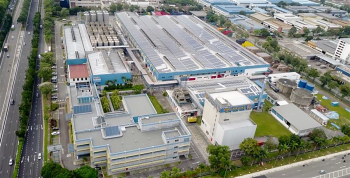
Dutch brewer Heineken will shift its brewing production from Singapore to Vietnam and Malaysia as part of its strategy to build a more agile regional supply approach.


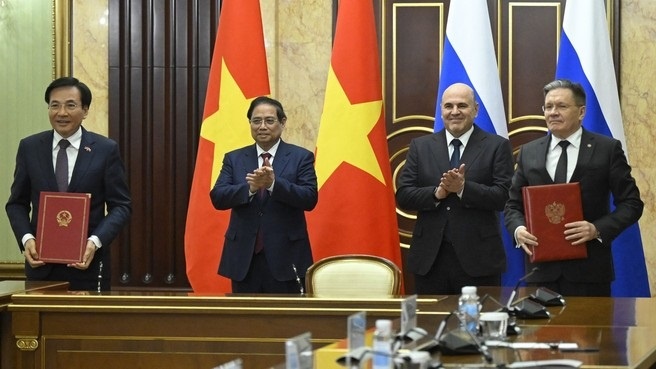 |
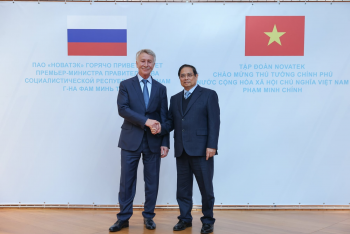
On March 23, the document was signed by Alexey Likhachev, director general of Rosatom, and Tran Van Son, Minister and Head of the Vietnamese Government Office. The ceremony took place in the presence of Russian Prime Minister Mikhail Mishustin and PM Chinh.
The agreement sets out the terms and key areas of cooperation for the nuclear power plant venture, which will involve the construction of two Russian-designed power units with VVER-1200 reactors, totalling 2,400 MW of installed capacity. The Leningrad NPP 2 (units No.1 and No.2) has been selected as the reference project. The document establishes the legal framework for construction and will guide Russian-Vietnamese cooperation in the nuclear field for decades to come.
"For us, this is not merely an agreement to build two nuclear power units. We see it as the foundation for a long term industrial partnership that will strengthen Vietnam's energy independence and open up new opportunities for economic growth," said Likhachev.
Rosatom possesses reference technologies for the construction of both large capacity nuclear power plants and small modular reactors. Russian VVER 1200 reactors are successfully operated in Russia and abroad, confirming the highest standards of safety and efficiency. Nuclear power plants with VVER 1200 reactors comply with the most stringent international requirements and form the core of Rosatom's export portfolio.
Russia and Vietnam have a long history of successful cooperation across various fields, and nuclear energy holds a special place in this partnership. In addition to the flagship Ninh Thuan 1 Nuclear Power Plant, the parties are continuing the implementation of the project to build a Centre for Nuclear Science and Technology (CNST) in Vietnam, which includes the construction of a Russian designed research reactor. The development of the feasibility study materials for the CNST will be completed in April, and the parties will begin discussing the contract for the construction of the centre.
Another area of longstanding cooperation is the successful operation of the Dalat research reactor, which uses Russian supplied fuel and provides Vietnam with medical isotopes. Currently, Vietnam is also expressing interest in participating in the international consortium based on the Multipurpose Fast Research Reactor.
Beyond traditional nuclear energy, cooperation is expanding into new promising areas: the development of logistics via the Northern Sea Route, container shipping by the FESCO transport group (part of Rosatom's management perimeter), additive technologies, and energy storage systems.